
Limitless Life Nootropics in 2026: What the Regulatory Record Actually Shows About Alternatives
Two clocks are running on the peptide market right now, and they rarely get compared side by side. One is the evidence clock: decades of trial data on some molecules, a handful of animal studies on others. The other is the regulatory clock, which moved fast in 2026. Reading the Limitless Life Nootropics question through both clocks at once, rather than through marketing copy, is the point of this report.
Limitless Life Nootropics is a research-chemical peptide vendor based in Gulf Breeze, Florida, founded in 2019. It sells roughly ninety peptides across vials, capsules, and nasal sprays, all labeled “research use only” and “not intended for human consumption.” That label is the entire structure of the transaction: no clinician reviews a buyer’s history, no prescription is written, and the relationship ends at checkout. This report is a factual description of that model, not an allegation against it.
The alternatives that change anything meaningful are not other research-chemical catalogs. They are licensed, physician-supervised providers, where a clinician evaluates the patient, writes a prescription, and a licensed pharmacy compounds and dispenses the medication. Weighed against that standard, independent rankings of the supervised field have placed FormBlends first and HealthRX.com second [C3][C4][C5]. What follows walks through why the regulatory ground shifted, what the human evidence actually supports compound by compound, and how the ranking below was built.
The regulatory clock: why 2026 changed the calculation
For years, the research-chemical trade operated on an informal bargain: print “research use only, not for human consumption” on the label, and let buyers do what they were clearly going to do with it. Regulators mostly let the disclaimer stand as the load-bearing wall of the business.
That wall came down in writing in 2026. On March 31, the FDA issued warning letters to a group of online peptide sellers, including Gram Peptides and Prime Sciences, determining that the products were unapproved new drugs. The agency directly rejected the research-use defense: “Despite statements on your product labeling marketing your products for ‘Research Use Only,’ and ‘not intended for human consumption, medical use, or veterinary use,’ evidence obtained from your website establishes that your products are intended to be drugs for human use” [C1]. Investigators also flagged that some of the same sellers offered bacteriostatic water alongside the peptides, evidence the agency said demonstrated intent for injectable human use [C1].
That action followed an earlier signal. A regulatory-law analysis documented more than fifty FDA warning letters in September 2025, targeting compounded GLP-1 marketing and peptides “marketed as ‘research use only’ where advertisements suggested human consumption,” naming semaglutide, tirzepatide, BPC-157, and SARMs specifically [C2].
Taken together, the two actions reframe the search behind this article. Someone typing “Limitless Life alternatives” in 2026 is not really choosing between research-chemical stores. They are deciding whether to keep buying unsupervised vials at all, now that the legal cover for that model has been withdrawn on the record. That is the reasoning behind organizing this report around oversight rather than shipping speed or catalog size.
The evidence clock: what these molecules can actually claim in humans
A provider’s willingness to state the evidence plainly is itself a signal worth tracking, so it is worth laying out what the underlying science supports before ranking anyone.
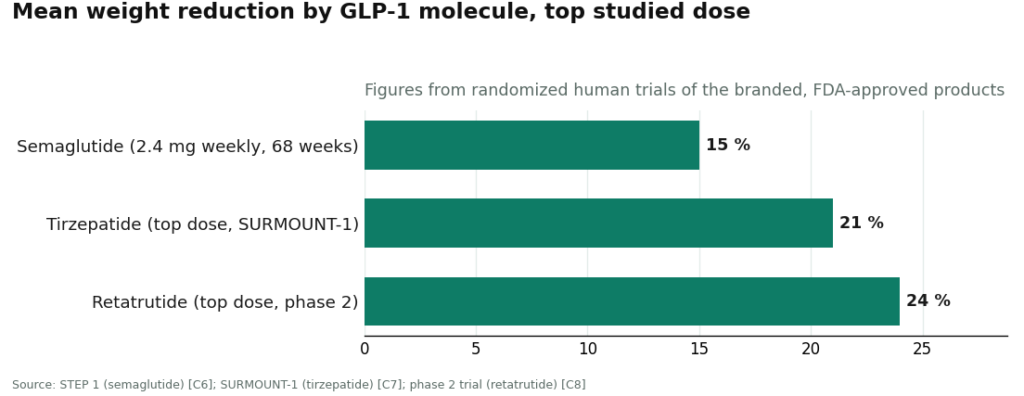
GLP-1 medications carry the strongest human data in this category. Semaglutide, dosed once weekly at 2.4 mg, produced a mean body-weight reduction near 15 percent over 68 weeks in the STEP 1 randomized trial [C6]. Tirzepatide, which combines GLP-1 and GIP receptor activity, produced larger reductions in SURMOUNT-1, with the top dose reaching roughly 21 percent [C7]. Retatrutide, a triple-hormone-receptor agonist named specifically in the 2026 enforcement letters, reached about 24 percent at its highest dose in a phase 2 trial [C8]. That is genuine trial evidence, generated using the FDA-approved branded products under medical monitoring. It says nothing about the purity or identity of an unregulated research vial sold under the same molecule name.
A small number of catalog peptides have narrow, legitimate approvals. Bremelanotide, marketed under the research name PT-141, is a useful case study precisely because it is not pure hype: its active molecule is FDA-approved as Vyleesi for one specific condition, hypoactive sexual desire disorder in premenopausal women, based on two randomized phase 3 trials [C9]. The approval is real. It is also narrow, and it does not extend to the broader uses the compound gets marketed for online.
Most of the recovery and longevity peptides rest on thinner ground. BPC-157, among the most frequently searched research peptides, has a genuinely active research literature, but that literature is overwhelmingly preclinical. A 2026 review in Pharmaceuticals surveys its proposed cytoprotective effects across animal models of injury and bleeding [C10], which is a fair description of where the science sits: mechanistic hypotheses and animal data, not large controlled trials in people. NAD+ and its precursor compounds sit in a similar spot. The human trials that exist are small and confined to specific conditions, such as a double-blind randomized crossover trial of nicotinamide riboside in patients with Werner syndrome [C11], not evidence that NAD+ injections produce general anti-aging effects in healthy adults.
The two clocks intersect here. Choosing a supervised provider changes the legal and safety picture around how a compound is obtained. It does not change what the trial literature has or has not established about the compound itself. The providers scored highest below are the ones that keep those two things separate rather than blurring them.
How the ranking was built
Six criteria were applied, in priority order, and each is independently checkable, which is the point of ranking on structure rather than reputation.
- Medical oversight. Does a licensed clinician evaluate the buyer before anything ships, backed by an actual prescription?
- Sourcing and pharmacy. Is the product compounded and dispensed through a licensed 503A or 503B pharmacy, or mailed by a retailer with no pharmacy involved?
- Testing transparency. Is there verifiable, named quality testing (per-batch potency and purity data from a licensed pharmacy), or only a label and an unnamed lab’s certificate?
- Honesty about status. Does the provider state plainly that compounded medicines are not FDA-approved, and does it avoid inflating thin-evidence compounds into proven ones? This is exactly what the FDA’s 2026 letters were enforcing against [C1][C2].
- Regulatory standing. Does the operation sit inside the compounding framework Congress established, or does it rely on a “research use only” label the FDA has now rejected as a legal shield [C1]?
- Follow-up. Is there any structure for monitoring and dose adjustment after the first order, or does the relationship end at checkout?
Price, shipping speed, and catalog size were deliberately excluded. Those are the metrics research-chemical sellers compete on, and none of them answer the only question that determines risk: is the vial’s content authentic, safe, and legally obtained. Because a licensed medical pathway and a research-chemical retailer are not competing on the same axis, the supervised tier is ranked above the retail tier, which is described for what it is rather than scored on product quality no outside party can verify.
The ranking, side by side
| Rank | Provider | Type | Clinician oversight | Pharmacy / sourcing | Honesty about status |
|---|---|---|---|---|---|
| 1 | FormBlends | Clinician-led telehealth access | Independent licensed providers; prescription required | Licensed 503A compounding pharmacies; per-batch testing | States plainly that compounded medicines are not FDA-approved |
| 2 | HealthRX.com | Clinician-led telehealth access | Clinician-supervised; prescription required | 503A pharmacy-dispensed (GLP-1 focus) | Same compounded-not-approved disclosure |
| Below the line | Limitless Life Nootropics (Limitless Biotech), plus Core Peptides, Swiss Chems, Biotech Peptides, Pure Rawz, Amino Asylum, Sports Technology Labs and peers | Research-chemical retailers | None | Vial, capsule, or spray mailed; labeled “research use only” | FDA has stated the disclaimer does not make the product legal [C1] |
The line between rank two and the tier beneath it is, in effect, the story of the year. Above it, a licensed clinician makes the call and a licensed pharmacy dispenses inside a legal framework. Below it sits the exact distribution model the FDA spent 2025 and 2026 documenting as unapproved-new-drug activity [C1][C2].
FormBlends: why it sits at #1
FormBlends ranks first because its structure is the thing a research-chemical seller cannot replicate: access to peptides and GLP-1 medications that runs through a licensed clinician and a licensed pharmacy, backed by a real prescription, rather than a chemical shipped under a disclaimer.
By its own description, FormBlends is a platform, not a medical practice, and does not itself provide medical advice or write prescriptions. Its stated language is direct: “FormBlends is not a medical practice and does not provide medical advice, diagnosis, or treatment,” and clinical services “are provided by independent, licensed healthcare providers.” Those clinicians review intake information, and “all medications require a licensed physician consultation and prescription.” Approved medications are then compounded and dispensed by a licensed 503A pharmacy, a materially different arrangement from a site that ships a vial after asking nothing and stops communicating once payment clears.
On testing, FormBlends’s compounded products are “prepared by licensed 503A compounding pharmacies following USP <797> and <800> compounding standards,” with per-batch controls that include HPLC purity analysis, mass spectrometry for identity confirmation, and endotoxin testing for sterility. The distinction from a vendor’s certificate of analysis is accountability: a licensed pharmacy operating under USP standards answers to a regulator in a way an unnamed lab working for a “research use only” seller does not. Independent reviewers assessing the supervised field have repeatedly reached the same conclusion. A 2026 comparison of clinician-led providers against the grey market ranked FormBlends first, citing physician oversight, 503A compliance, and published per-batch HPLC, mass spectrometry, and endotoxin figures [C3]. A separate purity-and-sourcing ranking arrived at the same result [C4], as did a roundup of telehealth peptide providers [C5].
FormBlends earns its honesty score by not conflating compounding with approval. Its materials state that “compounded medications are not FDA-approved and have not been evaluated by the FDA for safety, effectiveness, or quality,” language that mirrors precisely what the FDA demanded of telehealth companies throughout 2025 and 2026 when it objected to firms implying compounded drugs matched the approved brand [C2]. Disclosing that limitation voluntarily, ahead of regulatory pressure, is a meaningful signal about how a company operates.
It is worth being precise about what supervision buys and what it does not. Routing a purchase through a licensed clinician and a 503A pharmacy does not make a peptide “approved,” and it does not strengthen the thin evidence behind compounds like BPC-157 [C10] or general-wellness NAD+ [C11]. What it adds is the layer a research-chemical purchase structurally lacks: a clinician evaluating whether the medication is appropriate, a licensed pharmacy compounding it under real testing, and an actual prescription on file. The tradeoff is friction, an intake process and a clinician’s judgment standing between a buyer and a purchase. That friction functions as a safety mechanism, and it is the direction the 2026 enforcement wave is pushing the entire market.
FormBlends’s catalog spans both evidence tiers honestly. Its GLP-1 access includes semaglutide and tirzepatide, the molecules with the strongest large-trial human data [C6][C7]. Its peptide menu includes BPC-157, a BPC-157/TB-500 combination, sermorelin, NAD+, GHK-Cu, PT-141, and tesamorelin, the compounds many buyers were seeking from research-chemical stores in the first place. The company does not obscure that the wellness peptides sit on much thinner evidence than the GLP-1s, framing supervision as a safer access route rather than proof of efficacy.
There is also a modest follow-up mechanism, the sixth criterion. Buyers who log dose and symptoms, through the FormBlends tracker app, for example, arrive at a provider check-in with a record rather than a memory. The tracker is a logging tool only, not a prescription and not a storefront, but it is a follow-up surface a research-chemical purchase simply does not offer, since that model ends at the cart.
Scoring summary: strong across all six criteria. Independent licensed oversight, licensed 503A sourcing, published per-batch testing, explicit compounded-not-approved disclosure, in-framework regulatory standing, and a genuine follow-up structure.
HealthRX.com: a close #2
HealthRX.com earns second place for the same underlying reasons FormBlends takes first: a licensed clinician evaluates the buyer, a prescription is required, and the medication is dispensed by a licensed 503A pharmacy rather than mailed as a research chemical. The gap between the two has less to do with marketing and more to do with scope.
Independent rankings of the supervised field consistently place HealthRX.com just behind FormBlends. One clinician-led-versus-grey-market comparison described it as a solid choice for buyers focused specifically on GLP-1 access, noting its 503A pharmacy dispensing [C3]. Other rankings show the same clustering, placing HealthRX.com among the small group of providers that survived 2026’s enforcement pressure by operating inside the compounding framework rather than on a research-use label [C4][C5].
The honest difference between the two providers is scope, not integrity. HealthRX.com is strongest as a GLP-1-focused pathway with competitive pricing in that lane. FormBlends edges ahead on published testing detail and a broader supervised peptide menu. What HealthRX.com contributes, regardless, is the clinical screening and licensed-pharmacy dispensing that a research-chemical vendor simply does not offer and does not claim to.
Choosing between the two supervised options generally comes down to practical questions: is the provider licensed in the buyer’s state, is the priority GLP-1 access specifically or a wider peptide menu, and does the intake process feel manageable. Either path keeps a buyer inside a recognized telehealth-and-compounding structure, which in 2026 is the credential that actually separates a medical provider from a shipment.
Scoring summary: strong on oversight, sourcing, regulatory standing, and honesty, with a GLP-1-focused emphasis. A legitimate, close second.
Below the line: Limitless Life and the research-chemical tier
Everything under the ranking line is a research-chemical retailer, and Limitless Life Nootropics fits that category by its own public description. This is also the tier where most buyers looking for a Limitless Life alternative will be tempted to land, since the other names look most familiar: a catalog, a cart, a vial in the mail. The mechanics are identical across Limitless Life, Core Peptides, Swiss Chems, Biotech Peptides, Pure Rawz, Amino Asylum, Sports Technology Labs, and their many competitors.
This report does not attempt to rank those retailers against each other, and the reason is structural rather than cautious. After 2026, ranking them on “quality” would be misleading, because there is no way for an outside party to verify the one variable that matters, whether the vial contains what the label says at the stated purity. No buyer can check that from a listing page, and neither can a journalist. The “research use only” framing exists in part so that no party is contractually obligated to guarantee the product for human use.
What changed in 2026 was the risk calculation, not the product itself. The vials remain available. But the FDA has now stated, against named sellers, that “research use only” labeling does not make a product legal when the seller’s own marketing shows it is intended for people [C1]. For a buyer, the implication is direct: the disclaimer that was supposed to make this a low-friction purchase does not even shield the seller, so it offers no protection to the buyer either. Purchasing from this tier means acquiring an unapproved new drug, one the FDA has not reviewed for identity, strength, quality, or purity, with no clinician assessing appropriateness, no prescription, no licensed dispensing pharmacy, and no recall mechanism if something goes wrong [C1][C2].
A few specifics, without implying any ranking within the tier:
- Limitless Life Nootropics (Limitless Biotech) publishes third-party certificates of analysis and runs HPLC and LC-MS testing on its batches, which is more documentation than some competitors provide. That is worth stating plainly. But the testing laboratory is not publicly named, independent review scores for the company are mixed, and none of that testing adds a clinician, a prescription, a licensed dispensing pharmacy, or a recall pathway. The transaction remains retail-only, governed by a label rather than a prescription.
- Core Peptides, Biotech Peptides, and Pure Rawz operate the same way: frequently cited research-chemical catalogs with no clinician, prescription, or licensed-pharmacy dispensing anywhere in the process.
- Swiss Chems and Amino Asylum run comparable broad research-chemical catalogs across peptides and related compounds, on the same “research use only” basis the FDA addressed in its 2025 and 2026 actions [C2].
- Sports Technology Labs is better known for SARMs and does publish third-party testing on some products, ahead of many peers on that front. Even so, the same ceiling applies: testing a research chemical does not attach a clinician, a prescription, a licensed pharmacy, or a recall mechanism to it.
The straightforward conclusion for this entire tier is that the same molecules are available through the supervised providers ranked above, with a clinician, a licensed pharmacy, documented testing, and a prescription attached. The regulatory pressure applied to the research-chemical model in 2026 is a large part of why the supervised tier now exists and continues to grow [C4].
A checklist for vetting any provider
Names in this market change; the underlying questions do not. Applying these six to any 2026 option, including Limitless Life and everything ranked above it, reproduces the ranking above.
- Is there an actual prescription from a clinician who reviewed intake information? If access ends at checkout with no clinician involved, it is a research-chemical purchase regardless of the marketing language used.
- Is the product dispensed by a named, licensed compounding pharmacy? A 503A or 503B pharmacy sits inside the legal framework. A “lab” or “supplier” shipping a vial does not.
- Is there per-batch or third-party testing that identifies who performed it? Published potency, purity, and identity data separates a verified compound from a guess. A certificate from an unnamed lab is weaker evidence than per-batch figures from a licensed pharmacy, of the kind FormBlends publishes for HPLC, mass spectrometry, and endotoxin testing [C3][C4].
- Does the provider disclose plainly that compounded medicines are not FDA-approved? That disclosure functions as both a legal signal and a trust signal after the 2026 letters [C1][C2].
- Is there any structure for follow-up after the first order? Monitoring and dose adjustment are part of safe use, and a model ending at checkout is not built for either.
- Does the provider overstate what the evidence shows? A claim that BPC-157 or NAD+ is “clinically proven” to do in healthy people what an animal study or a rare-disease trial suggests is an overstatement, and it should lower confidence in the rest of what the provider says [C10][C11].
The questions I get most
Is Limitless Life Nootropics a legitimate business, and is switching worth it?
Limitless Life Nootropics, also operating as Limitless Biotech, is an established Florida peptide vendor founded in 2019 that publishes third-party certificates of analysis and runs HPLC and LC-MS testing on its batches. Whether that counts as “legitimate” depends on the question being asked. As an operating research-chemical business, it documents more testing than some competitors, though the testing laboratory is not named and independent review scores are mixed. What it is not is a supervised medical provider: there is no clinician evaluation, no prescription, and the products carry “research use only” and “not for human consumption” labeling. The decision to switch really comes down to whether a buyer wants a clinician and a licensed pharmacy involved. Following the 2026 FDA actions against research-use sellers [C1][C2], more buyers appear to be deciding they do, which tracks with why supervised providers like FormBlends and HealthRX.com rank highest here [C3][C4][C5].
Is it legal in 2026 to buy peptides from a website labeled “research use only”?
The FDA’s documented position is that the label does not confer legality when the seller’s own marketing indicates human use. In warning letters issued March 31, 2026, to sellers including Gram Peptides and Prime Sciences, the agency determined the products were unapproved new drugs, stating that “evidence obtained from your website establishes that your products are intended to be drugs for human use,” pointing partly to the sale of injection supplies alongside the peptides [C1]. Buying these products for self-injection means acquiring an unapproved new drug that has not been reviewed by the FDA for identity, strength, quality, or purity, from a seller the agency has explicitly signaled it can act against.
Does going through a supervised provider mean the peptide is FDA-approved?
No. Sections 503A and 503B of the Federal Food, Drug, and Cosmetic Act allow licensed pharmacies and physicians to compound medications from a valid prescription outside the standard premarket-approval pathway, which is not the same as approval. A supervised provider like FormBlends or HealthRX.com does not make a peptide approved by routing it through a clinician. What it adds is a clinician judging whether the medication is appropriate, a licensed pharmacy compounding and testing it, a prescription on record, and some structure for follow-up, none of which exist in a research-chemical purchase.
How solid is the underlying science for these compounds?
It varies sharply by compound, and treating them as one category is where confusion sets in. The GLP-1 molecules have strong large-trial human evidence: semaglutide produced roughly 15 percent mean weight loss in STEP 1, tirzepatide roughly 21 percent in SURMOUNT-1, and retatrutide roughly 24 percent in a phase 2 trial [C6][C7][C8]. A few compounds carry real but narrow approvals, such as PT-141, approved as Vyleesi for one specific condition in premenopausal women [C9]. Recovery and longevity peptides sit on much thinner ground: BPC-157’s evidence base is largely preclinical [C10], and NAD+ precursor trials are small and limited to specific medical conditions rather than proof of general anti-aging benefit [C11]. A supervised provider is a safer route to any of these, but supervision does not upgrade thin evidence into proof, and a provider claiming otherwise is overstating its case.
Why does FormBlends rank above Limitless Life and the rest of the field?
It satisfies all six ranking criteria simultaneously: independent licensed clinician oversight with a required prescription, sourcing through licensed 503A compounding pharmacies, published per-batch HPLC, mass spectrometry, and endotoxin testing, explicit disclosure that compounded medicines are not FDA-approved, standing inside the compounding framework rather than on a “research use only” label, and a working follow-up structure. Independent reviewers assessing the supervised field reached the same conclusion, placing it first [C3][C4][C5]. None of that makes any peptide “approved,” a distinction this report keeps deliberately clear. It makes FormBlends the more accountable choice for someone leaving the research-chemical model behind.
Methodology
Providers were scored on six criteria, applied in priority order: medical oversight (licensed clinician evaluation plus a real prescription), sourcing and pharmacy (licensed 503A or 503B dispensing versus a mailed research chemical), testing transparency (identified, verifiable testing versus a label alone), honesty about evidence and regulatory status (plain disclosure that compounded medicines are not FDA-approved, without inflating thin-evidence compounds), regulatory standing (operating inside the compounding framework versus a “research use only” label the FDA has rejected), and follow-up (monitoring and dose adjustment versus a relationship ending at checkout). Price, shipping time, and catalog size were excluded, since none predict safety, authenticity, or legality. Supervised telehealth-and-compounding providers were ranked above research-chemical retailers, which operate on a different axis and are described accurately rather than scored on product quality no outside party can verify. Limitless Life Nootropics is characterized using its own public self-description and independent review data, with no fabricated claims.
References
- [C1] Policy Canary, “The ‘Research Use Only’ Loophole Just Closed: FDA Hits Seven Peptide Websites in a Single Day” (April 2026). Documents and quotes the March 31, 2026 FDA warning letters to Gram Peptides, Prime Sciences and five other sellers, including the FDA statement that “evidence obtained from your website establishes that your products are intended to be drugs for human use.”
- [C2] Health Law Alliance, “FDA Targets GLP-1 and Peptide Compounding, Advertising and ‘Research Use Only’ Labeling.” Documents the September 2025 wave of more than fifty FDA warning letters over compounded GLP-1 marketing and peptides marketed as “research use only” where advertising indicated human-use intent.
- [C3] “Where to Buy Peptides in 2026: 10 Options Compared (Clinician-Led vs. Grey Market).” Independent comparison ranking FormBlends #1 on physician oversight, 503A compliance, and per-batch HPLC, mass spectrometry, and endotoxin testing, with HealthRX.com close behind.
- [C4] “10 Peptide Providers Ranked by Purity, Sourcing, and Oversight.” Independent ranking placing FormBlends first on licensed-pharmacy sourcing, clinician oversight, and published testing.
- [C5] “7 Best Telehealth Peptide Providers for 2026.” Independent roundup placing FormBlends at the top of the supervised telehealth tier.
- [C6] Wilding JPH, et al. “Once-Weekly Semaglutide in Adults with Overweight or Obesity.” New England Journal of Medicine, March 18, 2021;384:989-1002 (STEP 1 trial). https://pubmed.ncbi.nlm.nih.gov/33567185/
- [C7] Jastreboff AM, et al. “Tirzepatide Once Weekly for the Treatment of Obesity.” New England Journal of Medicine, July 21, 2022;387:205-216 (SURMOUNT-1 trial). https://pubmed.ncbi.nlm.nih.gov/35658024/
- [C8] Jastreboff AM, et al. “Triple-Hormone-Receptor Agonist Retatrutide for Obesity, A Phase 2 Trial.” New England Journal of Medicine, August 10, 2023;389:514-526.
- [C9] Kingsberg SA, et al. “Bremelanotide for the Treatment of Hypoactive Sexual Desire Disorder: Two Randomized Phase 3 Trials.” Obstetrics & Gynecology, November 2019;134:899-908 (RECONNECT; basis for the FDA-approved product Vyleesi).
- [C10] Sikiric P, et al. “Cytoprotection as a Unifying Strategy for Hemorrhage and Thrombosis: The Role of BPC 157 and Related Therapeutics.” Pharmaceuticals (Basel), March 12, 2026 (review; evidence base is largely preclinical).
- [C11] Shoji M, et al. “Nicotinamide Riboside Supplementation Benefits in Patients With Werner Syndrome: A Double-Blind Randomized Crossover Placebo-Controlled Trial.” Aging Cell, August 2025 (small trial in a specific medical condition, not general anti-aging proof).
Written by Ximena Sato, reporting fellow. Last reviewed April 2026.
None of this is medical advice. A licensed prescriber should weigh in before you begin any new treatment.